Syntropic Agroforestry Explained
What syntropic agroforestry actually is: succession, strata, dense planting, and why the line is the unit of design.
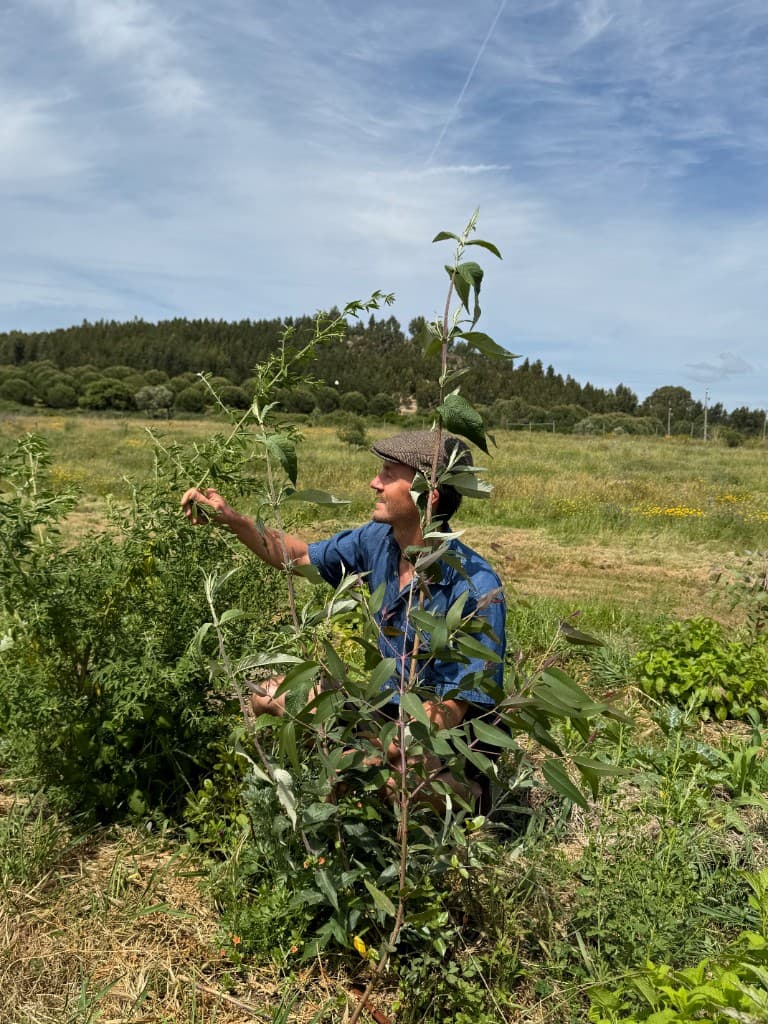
Jason van Alphen
Landscape & planting designer, founder of Syntroply
· Updated · 14 min read · Design & Planning
On this page
Syntropic agroforestry is a way of planting that copies how forests recover: many species, several heights, and a sequence from fast pioneers to long-lived canopy. Ernst Götsch developed the practice in Brazil; the same logic now shows up in Mediterranean and temperate projects because the physics is transferable. Sun, soil, and time still run the system. Species are the local dialect.
About Ernst Götsch
Ernst Götsch is a Swiss agricultural scientist and practitioner who developed Syntropic Agriculture after moving to Bahia, Brazil, in the early 1980s. He took over a heavily degraded, deforested farm named Fazenda Fugidos(“Escaped Farm”) and transformed it into a thriving, highly productive cocoa forest within a decade without external inputs or synthetic fertilizers.
Götsch repositioned humans not as exploiters or passive conservationists, but as active participants in natural succession. His work proved that food production and ecosystem restoration are not mutually exclusive; by mimicking how nature recovers, we can grow food while re-establishing fully functioning forest ecosystems.
Syntropy versus entropy
In classical physics, the second law of thermodynamics states that closed systems naturally move toward entropy — a state of disorder, energy dissipation, and structural breakdown. Conventional agriculture often speeds up this process: tilling, chemical inputs, and monoculture degrade soil structure, lose water, and deplete biological complexity over time.
Syntropy is the exact opposite. Coined by mathematician Luigi Fantappiè and applied to ecology, syntropy describes the tendency of life to organize, accumulate energy, build complex systems, and move from chaos to harmony. Instead of mining the soil, syntropic agroforestry harnesses biological momentum to generate an abundance of organic matter, water, and life.
What syntropic agroforestry is
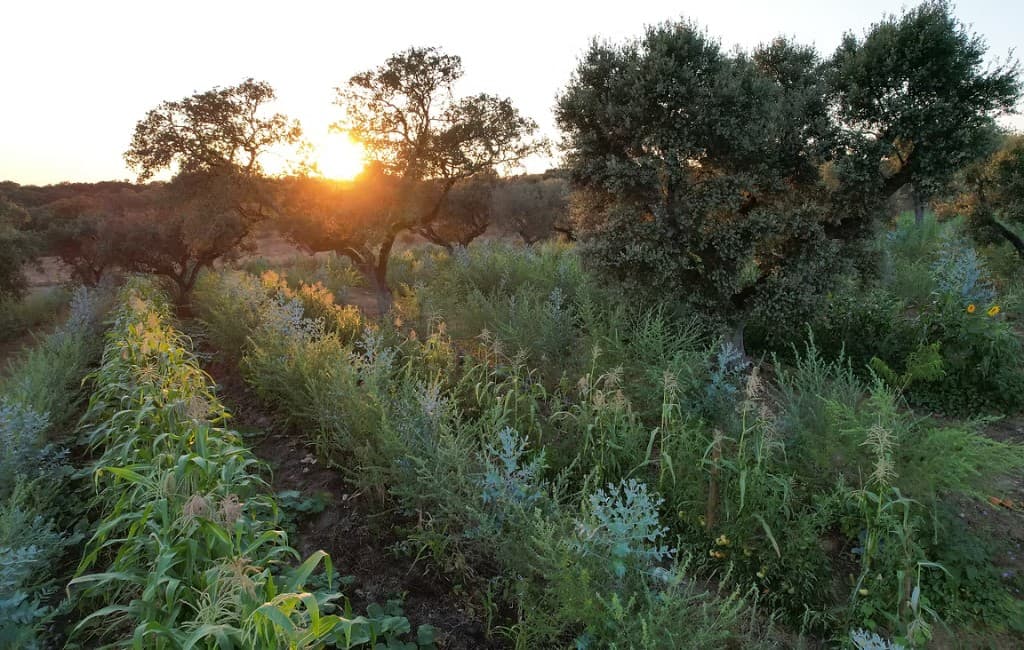
Three habits keep showing up in working systems. Plant denser than a conventional orchard so plants occupy the vertical profile quickly. Keep soil covered — living plants first, mulch second. And prune on a rhythm so light, biomass, and airflow stay in balance as the line matures.
That is why “syntropic” is not a plant list. Macadamia under banana under eucalyptus is a tropical expression of the idea. In Portugal or inland Spain the same idea might be stone pine, carob, pomegranate, and a dense shrub layer of tagasaste and rosemary. The pattern is strata plus succession.
The core principles
- Maximizing photosynthesis: keeping every layer of the canopy densely packed with living leaves year-round to convert maximum sunlight into biomass and root exudates.
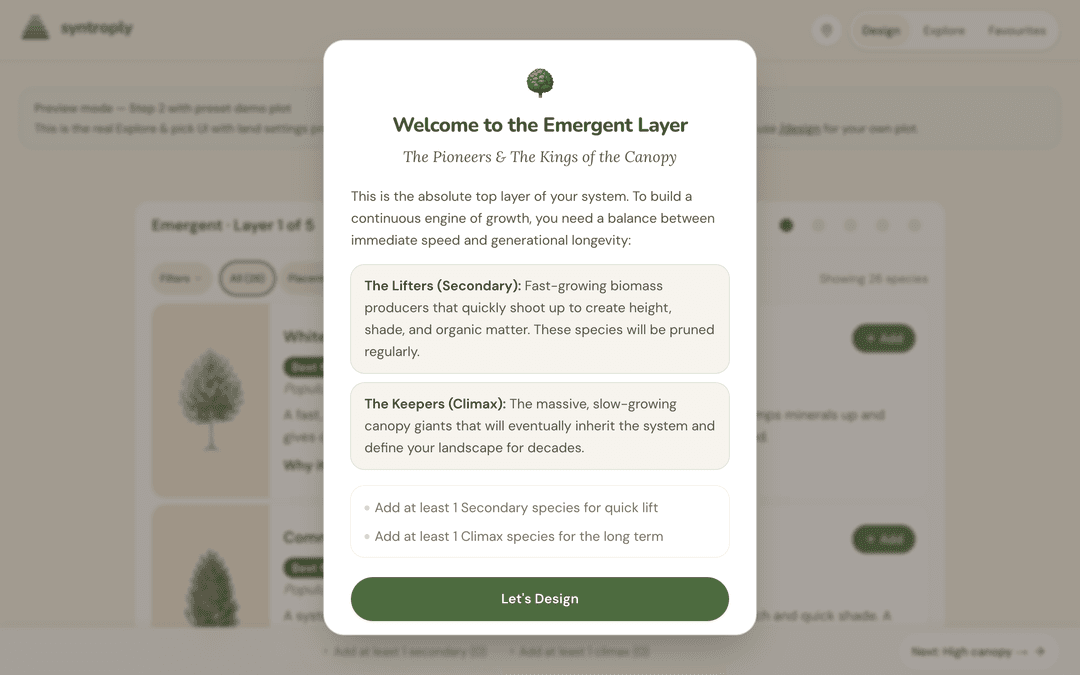
- Natural succession in time (consortia): planting species from different successional stages — placenta, secondary, and climax — together at day one. Fast-growing pioneer plants create microclimates and soil conditions for long-term trees.
- Stratification in space:occupying all vertical layers of the forest (emergent, high, medium, shrub, and ground covers) based on each species' light requirement, maximizing three-dimensional space.
- Heavy pruning and biomass cycling: regularly pruning pioneer species and shade canopy to drop biomass directly onto the soil. This triggers growth hormones (gibberellins) in neighboring plants and accelerates soil creation.
- Cooperation over competition: treating weeds, pests, and disease not as enemies to eradicate, but as ecological feedback signals indicating a system imbalance or an opportunity for succession.
Ecological succession stages
Syntropic agroforestry models the natural evolution of ecosystems over time, accelerating succession to rapidly build fertile topsoil and high-yielding systems. Plants are grouped into successional categories based on their lifecycle, growth rate, and role in system development:
- Placenta (I & II): short-lived pioneers (vegetables, annual crops, fast biomass grasses, and legumes) that establish immediate soil cover, break up hardpan, and generate initial organic matter.
- Secondary (I, II & III): medium-term trees and shrubs (fruit trees, berry bushes, fast-growing nitrogen fixers) that build microclimatic stability, filter light, and transition the site into an emerging forest ecosystem.
- Climax: long-lived canopy and emergent species (timber trees, slow-growing nut trees, climax fruit species) that anchor the mature forest, maintaining high stability, carbon storage, and nutrient cycling for decades.
The five strata
Most syntropic drawings use five layers. They are not decorative categories; they are a light budget. Each layer occupies a different band of the canopy so the line can be dense without every plant fighting for the same photons.
| Carob | Ceratonia siliqua | High | Full sun / low water | Deep-rooted canopy; slow to yield. |
| Pomegranate | Punica granatum | Medium | Full sun / moderate | Productive heart of many dry lines. |
| Stone pine | Pinus pinea | Emergent | Full sun / drought-tolerant once established | Long-lived frame tree; wide spacing. |
| Strawberry clover | Trifolium fragiferum | Ground cover | Sun to part shade / likes some moisture | Living mulch; keep soil covered. |
| Tagasaste | Chamaecytisus palmensis | Shrub | Sun / needs drainage | Nitrogen fixer and chop-and-drop biomass. |
The role of water and microclimate
Rather than relying purely on irrigation, syntropic design structures vegetation to act as a living water pump and sponge:
- Infiltration and moisture retention: continuous biomass mulch forms a protective layer over the soil, cutting evaporation losses and dramatically increasing organic matter, which holds multiple times its weight in water.
- Condensation and transpiration: deep-rooting trees pull water from deep subsoil layers and transpire moisture into the understory microclimate, raising ambient humidity and triggering localized condensation.
- Windbreak and temperature regulation: dense vertical layering reduces wind speed across growing beds, tempering extreme temperature fluctuations and reducing transpiration stress on cash crops.
Management and pruning dynamics
Pruning in syntropic agroforestry is not merely maintenance; it is the engine that drives energy through the ecosystem:
- Biomass accumulation: biomass lines (e.g. fast-growing nitrogen fixers, eucalyptus, grasses) are pruned heavily and frequently to deposit thick mulch directly onto crop rows.
- Hormonal growth triggers: severe pruning drops root mass underground, feeding soil microbes, while triggering systemic root-to-shoot growth hormones (gibberellins and cytokinins) across neighboring plants in the system.
- Light stratification management: strategic pruning manages light availability for lower strata, ensuring that every layer receives its precise required sunlight without allowing bare soil exposure.
How to start a line
You do not need a 12-hectare masterplan to begin. You need a climate read, a soil read, and a first module you can actually plant.
Read the site, not a wishlist
Frost, rainfall, drainage, and wind matter more than the fruit you hoped to grow. A species that fails the site will never become a pretty canopy.Pick a frame, then fill layers
Pick your emergents, then high and medium producers, then shrubs and ground cover. Empty layers are a design error, not a style.Plant dense, plan the pruning
Density is a strategy, not clutter. If you cannot say when the biomass species get cut, the line will stall in shade.Source what you can actually buy
A perfect Latin name is useless if the nursery cannot supply it. We usually use species that are available locally.
Frequently asked questions
Is syntropic agroforestry the same as a food forest?
They overlap. A food forest is usually a mixed planting of edible layers. Syntropic agroforestry is more specific: it uses accelerated succession, dense stratified planting, and regular pruning (chop-and-drop) to build soil and microclimate faster than a loosely planted orchard.
Does it only work in the tropics?
No. The principles such as strata, succession, covered soil, and biomass cycling work in Mediterranean and temperate climates. You change the species, spacing, and irrigation, not the logic.
How is this different from a conventional orchard?
A conventional orchard usually holds one canopy age in full sun, with bare or grassed alleys. A syntropic line stacks ages and layers, keeps soil covered, and treats pruning as fertility rather than waste.
Jason van Alphen
Landscape & planting designer, founder of Syntroply
Jason is a working agroforestry designer. He built Syntroply to match species to land, draw a tree line, and take that line through sourcing, planting, and season-by-season care — the missing practical layer between theory and a planted system.
Design your own food forest with Syntroply
Match species to your climate and soil, draw a syntropic tree line, and take it from plan to planting.
Start a design