Carob tree
Ceratonia siliqua
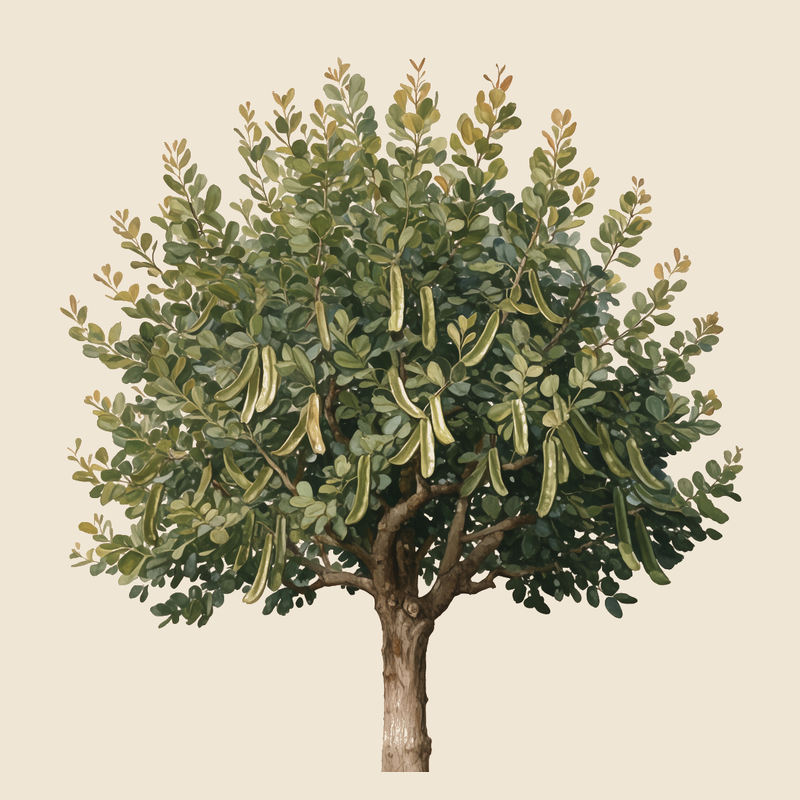
A drought-proof Mediterranean stalwart that crops sweet, protein-rich pods on almost no water. Slow and long-lived — just remember it needs a male and female to fruit, and it's frost-shy.
Carob tree in a syntropic line
Carob is a High-layer Climax producer for free-draining, alkaline sites. Use it as a durable backbone beside olive or almond, with pioneer shrubs fixing nitrogen underneath. It casts light shade — keep medium citrus and figs toward the brighter gaps as the canopy fills.
Tolerances and growing conditions
- Strata
- High
- Lifecycle
- Climax
- Soil preference
- Rocky, Sandy
- Soil pH range
- 6.2 – 8.5
- Min. temperature
- -4°C
- Min. rainfall
- 350 mm/year
- Wind tolerance
- High
- Frost tolerance
- Low
- Growth rate
- Slow
- Irrigation needed
- Low
- Foliage
- Evergreen
- Waterlogging tolerance
- Low
- Origin
- Mediterranean
- Native to Portugal
- No
How to manage it
Give it space and lift the canopy with light structural pruning to allow understory cropping; deep taproot makes it very drought-hardy once established.
How to prune
Carob wants only light, gradual structural lifting in winter — remove dead wood and awkward low crossing limbs to raise the canopy for underplanting. Avoid heavy cuts, as carob heals slowly and bleeds gum; let it keep a broad, dense evergreen head otherwise.
How to propagate
Soak seed 24 hours before sowing; named cultivars are grafted and trees are dioecious.
Guidance, not a guarantee — success varies by species and skill.
What to watch out for
Dioecious — needs both male and female trees (or a self-fertile grafted cultivar) to set pods. Unlike most legumes it does not fix nitrogen. Young trees frost-tender below about −4 °C.
Frequently asked questions about Carob tree
Is carob tree frost-hardy?
Yes for winter cold in many climates — generally hardy to around -4°C when dormant, with low frost tolerance in the catalog. Flowering crops can still lose a season to late frost, so site them carefully.
What soil does carob tree need?
It does best on rocky, sandy ground, at pH about 6.2–8.5.
How much water does carob tree need?
Plan for a rainfall floor around 350 mm/year, plus low irrigation once established.
Can carob tree handle wet or waterlogged soil?
Poorly — carob tree has low waterlogging tolerance, so keep it off winter-wet clay and standing water.
What should I watch out for with carob tree?
Dioecious — needs both male and female trees (or a self-fertile grafted cultivar) to set pods. Unlike most legumes it does not fix nitrogen. Young trees frost-tender below about −4 °C.
Carob tree in soil templates
Design your line to see how your land fits Carob tree.
Start designing your line →