Bay laurel
Laurus nobilis
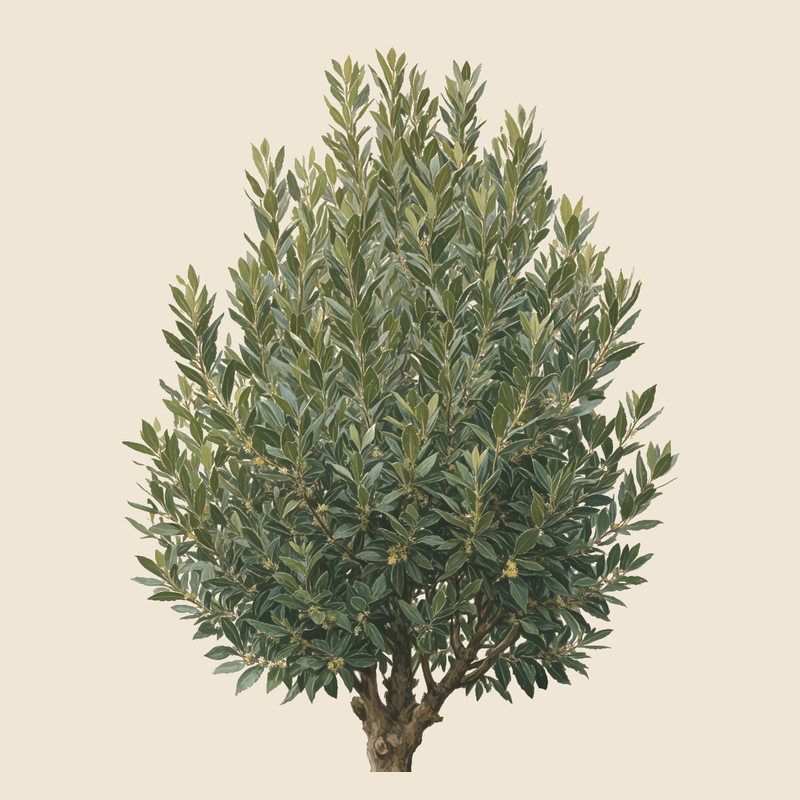
A slow, shade-tolerant evergreen anchor that gives you bay leaves for the kitchen and clips into handsome hedges. Drought-hardy once settled, but hard frost can scorch it.
Bay laurel in a syntropic line
Bay laurel belongs in the Medium layer as a Climax species. The productive heart — most of your yield lives here. Rough in-row spacing starts around 2.7 m in a syntropic row. Good line partners include Aspen, Avocado, Black locust. As a Climax species it is meant to stay for the long term — protect its light and root space as pioneers fade.
Tolerances and growing conditions
- Strata
- Medium
- Lifecycle
- Climax
- Soil preference
- Loam, Sandy
- Soil pH range
- 6 – 8
- Min. temperature
- -10°C
- Min. rainfall
- 500 mm/year
- Wind tolerance
- High
- Frost tolerance
- Medium
- Growth rate
- Slow
- Irrigation needed
- Low
- Foliage
- Evergreen
- Waterlogging tolerance
- Medium
- Origin
- Mediterranean
- Native to Portugal
- No
How to manage it
Shade-tolerant evergreen culinary tree that clips beautifully for hedges or topiary; drought-hardy once established.
How to propagate
Take softwood cuttings in summer or hardwood in winter; rooting is slower than other shrubs.
Guidance, not a guarantee — success varies by species and skill.
What to watch out for
Slow-growing and low mulch output, so don't count on it for biomass; hard frost scorches foliage and it suckers into a thicket if unmanaged.
Frequently asked questions about Bay laurel
Is bay laurel frost-hardy?
Yes for winter cold in many climates — generally hardy to around -10°C when dormant, with medium frost tolerance in the catalog. Flowering crops can still lose a season to late frost, so site them carefully.
What soil does bay laurel need?
It does best on loam, sandy ground, at pH about 6–8.
How much water does bay laurel need?
Plan for a rainfall floor around 500 mm/year, plus low irrigation once established.
Can bay laurel handle wet or waterlogged soil?
It has medium waterlogging tolerance — short winter wet is usually fine, standing water is not.
What should I watch out for with bay laurel?
Slow-growing and low mulch output, so don't count on it for biomass; hard frost scorches foliage and it suckers into a thicket if unmanaged.
Design your line to see how your land fits Bay laurel.
Start designing your line →