Cape gooseberry
Physalis peruviana
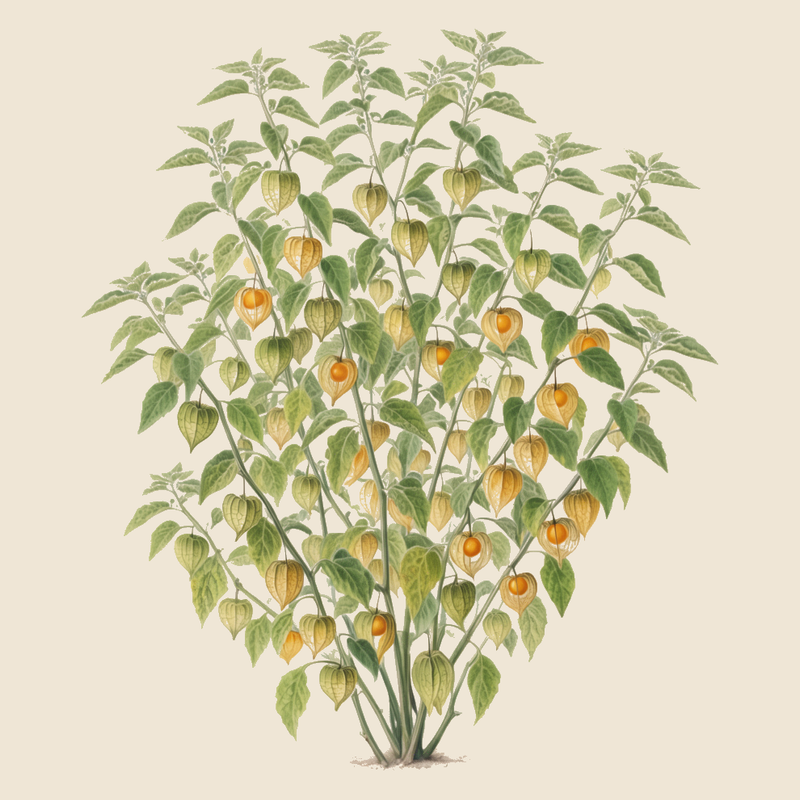
A lantern-husked shrub fruit — Cape gooseberry (goldenberry). Frost-tender; only ripe fruit is edible, green parts are toxic.
Cape gooseberry in a syntropic line
Cape gooseberry belongs in the Shrub layer as a Placenta productive species. Support species, fruit, and nitrogen fixers under the canopy. Rough in-row spacing starts around 1.5 m in a syntropic row. Good line partners include Black locust, Blue-leaf wattle. As a Placenta species it establishes fast, then gets cut back or phased out as longer-lived layers take over.
Tolerances and growing conditions
- Strata
- Shrub
- Lifecycle
- Placenta
- Soil preference
- Loam, Sandy
- Soil pH range
- 5.5 – 7.5
- Min. temperature
- -1°C
- Min. rainfall
- 600 mm/year
- Wind tolerance
- Low
- Frost tolerance
- Low
- Growth rate
- Fast
- Irrigation needed
- Medium
- Foliage
- Deciduous
- Waterlogging tolerance
- Medium
- Origin
- South America
- Native to Portugal
- No
How to manage it
Soft-wooded fruit shrub; tip-pinch young plants for a bushier habit and stake in windy sites. Harvest when husks dry and papery and fruit turns deep gold.
How to prune
This soft, short-lived shrub needs almost no winter structural pruning; frost usually kills top growth back naturally. If it survives, cut frost-damaged stems to the base in late winter to force fresh basal shoots. Avoid treating it like a woody tree - it regrows better from hard renewal than from selective shaping.
How to propagate
Sow seed indoors or take softwood cuttings; both establish quickly.
Guidance, not a guarantee — success varies by species and skill.
What to watch out for
Frost-tender — tops die back near 0 C. Unripe fruit and green parts contain toxic alkaloids; eat only ripe Cape gooseberries in dry husks. Can self-seed freely in mild climates.
Frequently asked questions about Cape gooseberry
Is cape gooseberry frost-hardy?
Yes for winter cold in many climates — generally hardy to around -1°C when dormant, with low frost tolerance in the catalog. Flowering crops can still lose a season to late frost, so site them carefully.
What soil does cape gooseberry need?
It does best on loam, sandy ground, at pH about 5.5–7.5.
How much water does cape gooseberry need?
Plan for a rainfall floor around 600 mm/year, plus medium irrigation once established.
Can cape gooseberry handle wet or waterlogged soil?
It has medium waterlogging tolerance — short winter wet is usually fine, standing water is not.
What should I watch out for with cape gooseberry?
Frost-tender — tops die back near 0 C. Unripe fruit and green parts contain toxic alkaloids; eat only ripe Cape gooseberries in dry husks. Can self-seed freely in mild climates.
Design your line to see how your land fits Cape gooseberry.
Start designing your line →