Italian alder
Alnus cordata
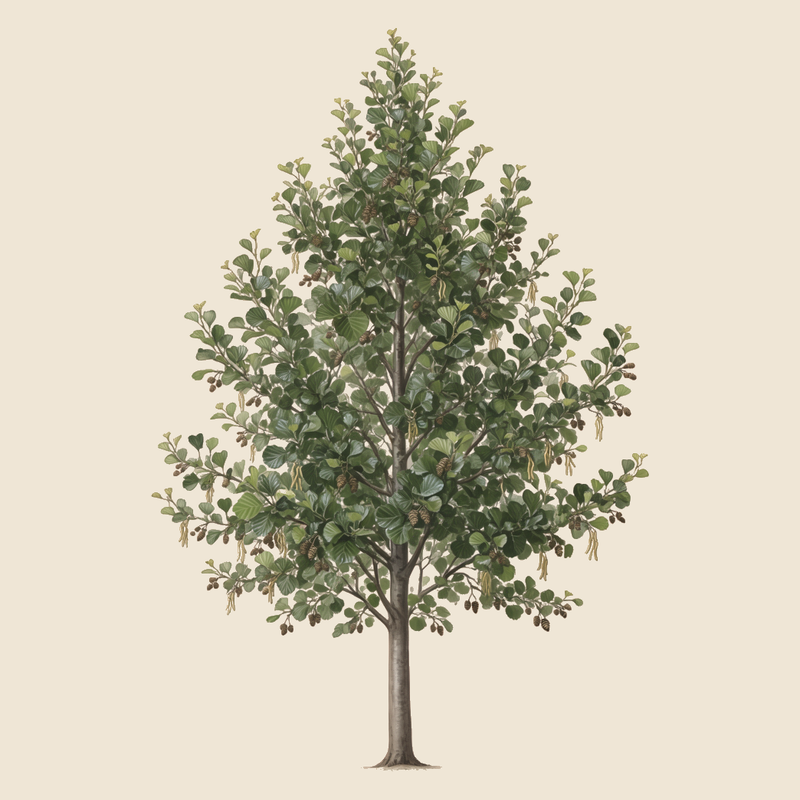
A tough pioneer and free fertiliser factory in one: fast-growing, nitrogen-fixing and happy on poor or dry ground where other alders sulk. Coppices readily for biomass, but seeds around freely if left unchecked.
Italian alder in a syntropic line
Italian alder belongs in the High layer as a Secondary nitrogen-fixing biomass species. Main production and shade trees for the line. Rough in-row spacing starts around 1.9 m in a syntropic row. Good line partners include Almond, Apple. As a Secondary species it carries mid-term yield and structure while climax trees slowly claim the canopy.
Tolerances and growing conditions
- Strata
- High
- Lifecycle
- Secondary
- Soil preference
- Loam, Clay, Sandy
- Soil pH range
- 5.5 – 8
- Min. temperature
- -15°C
- Min. rainfall
- 600 mm/year
- Wind tolerance
- High
- Frost tolerance
- High
- Growth rate
- Fast
- Irrigation needed
- Low
- Foliage
- Deciduous
- Waterlogging tolerance
- High
- Origin
- Mediterranean
- Native to Portugal
- No
How to manage it
Coppice or pollard for biomass and use as a nurse tree to shelter slower climax species; tolerates poorer, drier and more alkaline soils than most alders.
How to propagate
Sow seed direct or take dormant hardwood cuttings; coppices vigorously.
Guidance, not a guarantee — success varies by species and skill.
What to watch out for
Can self-seed readily and become weedy in open ground; vigorous roots may disturb nearby paving or drains. Actinorhizal N-fixer (Frankia) — do not expect rhizobial-style nodulation.
Frequently asked questions about Italian alder
Is italian alder frost-hardy?
Yes for winter cold in many climates — generally hardy to around -15°C when dormant, with high frost tolerance in the catalog. Flowering crops can still lose a season to late frost, so site them carefully.
What soil does italian alder need?
It does best on loam, clay, sandy ground, at pH about 5.5–8.
How much water does italian alder need?
Plan for a rainfall floor around 600 mm/year, plus low irrigation once established.
Can italian alder handle wet or waterlogged soil?
Yes — italian alder has high waterlogging tolerance and copes with winter-wet ground.
What should I watch out for with italian alder?
Can self-seed readily and become weedy in open ground; vigorous roots may disturb nearby paving or drains. Actinorhizal N-fixer (Frankia) — do not expect rhizobial-style nodulation.
Design your line to see how your land fits Italian alder.
Start designing your line →