Sweet cherry
Prunus avium
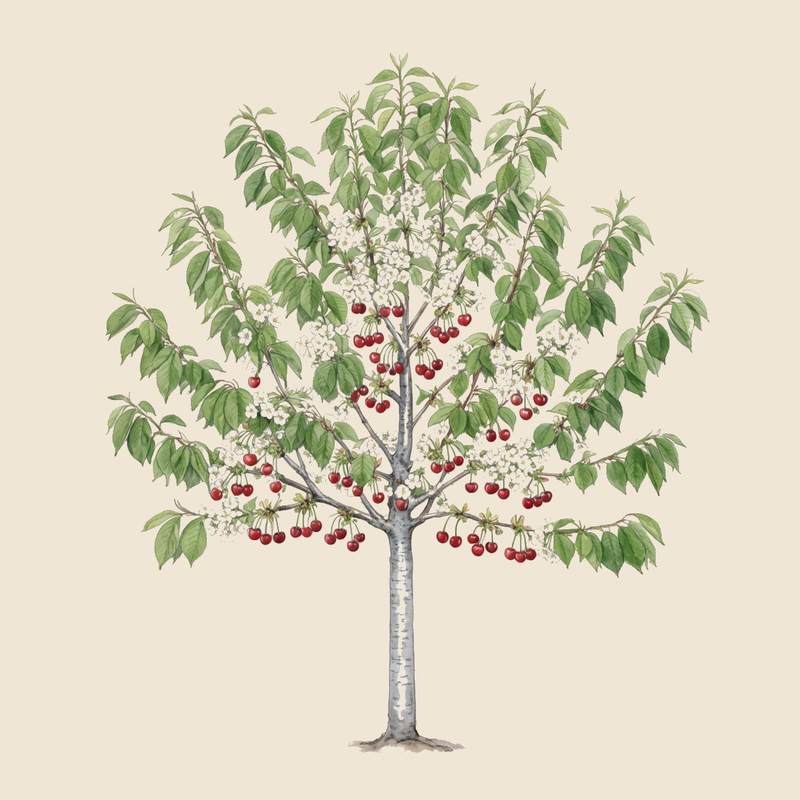
A classic fruit tree grown for sweet cherries and spring blossom, best kept in check on a dwarfing rootstock. Most varieties need a pollination partner, and birds will fight you for the harvest.
Sweet cherry in a syntropic line
Sweet cherry belongs in the High layer as a Secondary productive species. Main production and shade trees for the line. Rough in-row spacing starts around 6 m in a syntropic row. Good line partners include Black locust, Blue-leaf wattle. As a Secondary species it carries mid-term yield and structure while climax trees slowly claim the canopy.
Tolerances and growing conditions
- Strata
- High
- Lifecycle
- Secondary
- Soil preference
- Loam, Sandy
- Soil pH range
- 6 – 7.5
- Min. temperature
- -28°C
- Min. rainfall
- 600 mm/year
- Wind tolerance
- Medium
- Frost tolerance
- High
- Growth rate
- Medium
- Irrigation needed
- Medium
- Foliage
- Deciduous
- Waterlogging tolerance
- Low
- Origin
- Europe
- Native to Portugal
- Yes
How to manage it
Vigorous on seedling rootstock; use a dwarfing rootstock and summer-prune to keep it manageable. Prune only in dry summer weather to avoid disease entry.
How to prune
Do not dormant-prune sweet cherry—bacterial canker and silver leaf enter through winter cuts. Limit winter work to removing obviously dead or broken wood only; do structural shaping to an open-centre or central-leader form in dry summer weather instead.
How to propagate
Named sweet cherry cultivars must be grafted onto dwarfing rootstock; hardwood cuttings alone won't preserve variety.
Guidance, not a guarantee — success varies by species and skill.
What to watch out for
Most cultivars need a compatible cross-pollination partner; needs winter chill to fruit; birds take the crop; prune in summer, not winter, to avoid silver leaf and bacterial canker.
Frequently asked questions about Sweet cherry
Is sweet cherry frost-hardy?
Yes for winter cold in many climates — generally hardy to around -28°C when dormant, with high frost tolerance in the catalog. Flowering crops can still lose a season to late frost, so site them carefully.
What soil does sweet cherry need?
It does best on loam, sandy ground, at pH about 6–7.5.
How much water does sweet cherry need?
Plan for a rainfall floor around 600 mm/year, plus medium irrigation once established.
Can sweet cherry handle wet or waterlogged soil?
Poorly — sweet cherry has low waterlogging tolerance, so keep it off winter-wet clay and standing water.
What should I watch out for with sweet cherry?
Most cultivars need a compatible cross-pollination partner; needs winter chill to fruit; birds take the crop; prune in summer, not winter, to avoid silver leaf and bacterial canker.
Sweet cherry in soil templates
Design your line to see how your land fits Sweet cherry.
Start designing your line →