Pakistan mulberry
Morus macroura
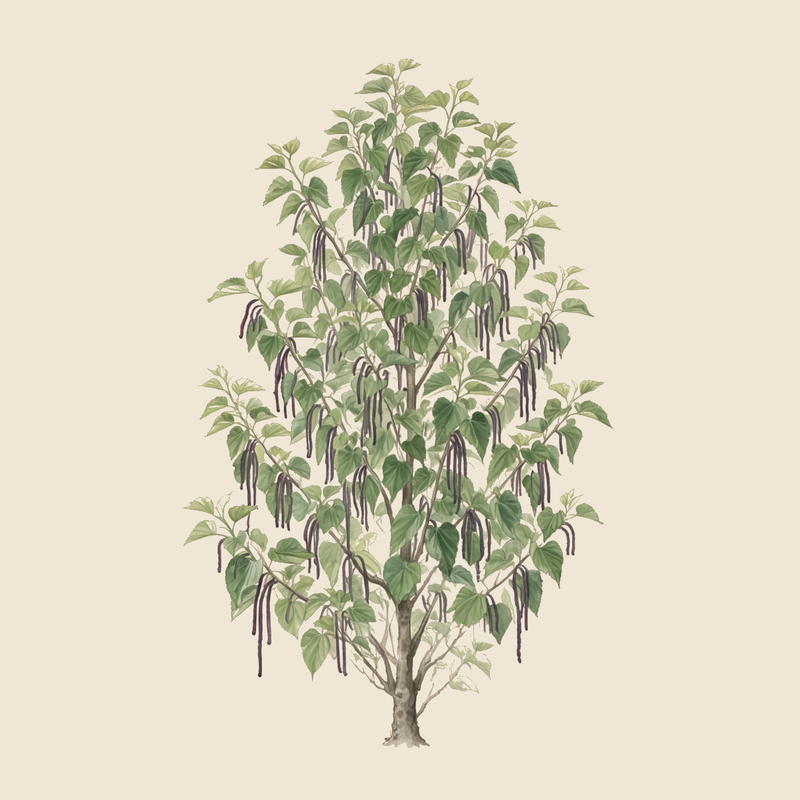
A vigorous mulberry famous for its extraordinarily long, sweet fruit — a real conversation piece that crops heavily. More frost-tender than other mulberries, so give it warmth.
Pakistan mulberry in a syntropic line
Pakistan mulberry belongs in the High layer as a Secondary productive biomass species. Main production and shade trees for the line. Rough in-row spacing starts around 2.3 m in a syntropic row. Good line partners include Pigeon pea, Russian olive. As a Secondary species it carries mid-term yield and structure while climax trees slowly claim the canopy.
Tolerances and growing conditions
- Strata
- High
- Lifecycle
- Secondary
- Soil preference
- Loam, Sandy
- Soil pH range
- 6 – 7.5
- Min. temperature
- -7°C
- Min. rainfall
- 600 mm/year
- Wind tolerance
- Medium
- Frost tolerance
- Low
- Growth rate
- Fast
- Irrigation needed
- Medium
- Foliage
- Deciduous
- Waterlogging tolerance
- Medium
- Origin
- East Asia
- Native to Portugal
- No
How to manage it
Vigorous fruit tree known for very long fruit clusters; responds well to pollarding for size control and steady mulch.
How to prune
Cut back long whips hard to a low pollard framework, removing crossing and inward growth to control its vigorous size. Aim for a manageable multi-branched head rather than a tall leader. Responds well to hard dormant cuts, so prune firmly.
How to propagate
Push hardwood cuttings into moist ground in winter or layer low branches.
Guidance, not a guarantee — success varies by species and skill.
What to watch out for
More frost-tender than white or black mulberry, especially when young - protect in cold sites. Species is dioecious in the wild, so confirm you have a known fruiting cultivar; can also grow very large if left unpruned.
Frequently asked questions about Pakistan mulberry
Is pakistan mulberry frost-hardy?
Yes for winter cold in many climates — generally hardy to around -7°C when dormant, with low frost tolerance in the catalog. Flowering crops can still lose a season to late frost, so site them carefully.
What soil does pakistan mulberry need?
It does best on loam, sandy ground, at pH about 6–7.5.
How much water does pakistan mulberry need?
Plan for a rainfall floor around 600 mm/year, plus medium irrigation once established.
Can pakistan mulberry handle wet or waterlogged soil?
It has medium waterlogging tolerance — short winter wet is usually fine, standing water is not.
What should I watch out for with pakistan mulberry?
More frost-tender than white or black mulberry, especially when young - protect in cold sites. Species is dioecious in the wild, so confirm you have a known fruiting cultivar; can also grow very large if left unpruned.
Design your line to see how your land fits Pakistan mulberry.
Start designing your line →